

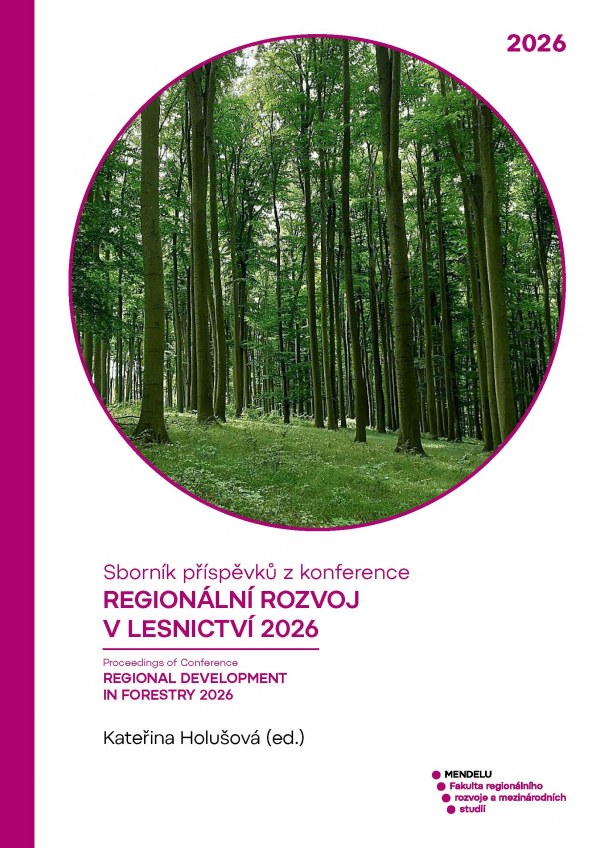
ISBN online: 978-80-7701-096-2 | DOI: 10.11118/978-80-7701-096-2
Regionální rozvoj v lesnictví 2026 | Regional development in Forestry 2026
23.–23. 4. 2026 Brno
- Kateřina Holušová (ed.)
Konference Regionální rozvoj v lesnictví byla zaměřena na problematiku s cílem informovat, diskutovat a představit možnosti, realizace a návrhy v rámci regionálního rozvoje s výrazným dopadem do lesnictví nebo z pohledu lesnictví. Stěžejním zaměřením bylo hledání možností pro nastolení řešení ekonomických a sociálních aspektů, které se váží na lesnictví. Sborník z konference rovněž obsahuje příspěvky, které byly připraveny v rámci tříletého projektu Návrh možností udržitelného regionálního rozvoje lesnictví z pohledu bioekonomiky (TQ01000532), řešeném na Fakultě regionálního rozvoje a mezinárodních studií, Mendelovy univerzity v Brně. Převážně se prezentovaná tématika v příspěvcích věnuje otázkám lesnického plánování a propojení lesnických politik a politik regionálního rozvoje; zvláště klade důraz na představení problematiky oblastních plánů rozvoje lesů; dále strategiím a koncepcím, které mají vazbu na udržitelný rozvoj lesnictví ve vazbě na bioekonomiku; sociálně-ekonomickým aspektům v rámci lesnictví a možné vazbě na regionální rozvoj; historii lesnictví a jejímu regionálnímu dopadu atd. Ve sborníku nejsou plně prezentovány všechny příspěvky, které na konferenci v roce 2026 zazněli. Věříme, že problematika regionálního rozvoje ve spojení s lesnictvím bude v budoucnu nadále rozšiřována a prohlubována.
online: 2026, vydavatel: Mendelova univerzita v Brně
 |
Příspěvky konference
DIFERENCIACE PŘÍRODNÍCH PODMÍNEK, POROSTNÍ POMĚRY A FUNKČNÍ ZAMĚŘENÍ JAKO ZÁKLAD LESNICKÉHO MANAGEMENTU
Petr Dujka, Pavel Gryga
DOI: 10.11118/978-80-7701-096-2-0005
Oblastní plány rozvoje lesů (OPRL) představují klíčový nástroj státní lesnické politiky České republiky, založený na specifickém přístupu lesnického managementu podmíněného přírodní rozmanitostí naší krajiny. Příspěvek prezentuje tuto diferenciaci na příkladu srovnání dvou přírodních lesních oblastí (PLO) – PLO 29 Nízký Jeseník a PLO 41 Hostýnskovsetínské vrchy a Javorníky. Srovnání zahrnuje tři analytické roviny: zastoupení lesních vegetačních stupňů a edafických kategorií jako vyjádření stanovištního potenciálu, historický vývoj a současnou strukturu dřevinné skladby a kategorizaci lesů reflektující jejich funkční využití. Výsledky analytické části OPRL ukazují, že přes určité podobnosti existují mezi oblastmi výrazné rozdíly – v geologickém složení a navazující trofnosti půd, potenciálu lesních společenstev, historickém trendu proměny druhové skladby i ve funkčním zařazení lesů vyjádřeném jejich kategorizací. Tyto rozdíly dokládají nezbytnost regionálně diferencovaného přístupu k lesnickému plánování a managementu, zejména v kontextu probíhající klimatické změny.
ZÁKLADNÍ VÝSTUPY OBLASTNÍCH PLÁNŮ ROZVOJE LESŮ PRO PŘÍRODNÍ LESNÍ OBLASTI 29 NÍZKÝ JESENÍK A 41 HOSTÝNSKOVSETÍNSKÉ VRCHY A JAVORNÍKY
Štěpán Křístek, Jan Hubený
DOI: 10.11118/978-80-7701-096-2-0015
Regional plans of forest development serve as a tool for differentiating forest management at the supra-regional and regional levels. Differentiation based on natural and socio-economic conditions and the condition of stands at the regional level is applied in framework planning and basic management recommendations through target management groups and stand types. Differentiation at the supra-regional level is demonstrated by comparing two natural forest areas (NFA): 29 – Nízký Jeseník = lower Hercynian upland areas affected by nonspecific spruce dieback, and NFA 41 – Hostýnskovsetínské vrchy a Javorníky = Carpathian upland areas affected by a recent bark beetle calamity since 2015. Key outputs regarding production security, risks of climate change impacts, transport accessibility, and framework management guidelines are presented. The impacts of the proposed measures are illustrated using a model of changes in stand species composition and the development of timber stocks and harvesting potential.
OBLASTNÍ PLÁNY ROZVOJE LESŮ – NÁSTROJ REGIONÁLNÍHO ROZVOJE
Robert Hruban
DOI: 10.11118/978-80-7701-096-2-0031
The paper presents Regional Plans of Forest Development (RPFD) as a tool of state forest policy that, at the level of natural forest areas, links site analyses and forest condition assessments with practical recommendations in the form of framework silvicultural guidelines. The methodology of RPFD combines information on forest sites and stands with thematic ecosystem analyses; the results are made available through written documentation and the RPFD map application. The second cycle of RPFD processing (2019–2025) confirmed the growing need for differentiated recommendations in the context of climate change and increased forest disturbances, and demonstrated that RPFD provide a unified reference framework for state administration, forest owners and forest management plan makers.
VÝZNAM LESNICTVÍ VE STRATEGICKÝCH DOKUMENTECH NA RŮZNÝCH ÚZEMNÍCH ÚROVNÍCH
Zdeněk Šilhan, Kateřina Holušová
DOI: 10.11118/978-80-7701-096-2-0040
This paper focuses on the relationship between regional development and forestry and examines the role assigned to forestry in strategic and conceptual documents at different territorial levels. The aim of the study is to analyse the importance of forestry in supranational, national, regional, and local strategies and to identify the main themes associated with it in these documents. Methodologically, the research is based on a content analysis of selected strategic documents, in which keywords related to forests and forestry were identified and their thematic context subsequently evaluated. The analysis included supranational and national strategies as well as the strategies of municipalities and Local Action Groups located in areas where an important forestry actor operates. The results show that forestry is most frequently addressed in national and supranational strategies, while it appears less often at lower territorial levels. At the same time, however, the findings confirm that when forestry is reflected at the local and regional level, it is usually treated more specifically and in greater detail. The most frequent themes include sustainable forestry and biodiversity, climate change adaptation, water regime in forests, economic competitiveness, and the social and non-productive functions of forests. The study therefore shows that the significance of forestry in strategic planning is determined not only by the frequency of references, but also by the depth and specificity with which the topic is addressed.
METROPOLITNÍ KAPITULA U SVATÉHO VÁCLAVA V OLOMOUCI A JEJÍ PŘÍNOS K REGIONÁLNÍMU ROZVOJI V LESNICTVÍ
Tomáš Badal, Kateřina Holušová
DOI: 10.11118/978-80-7701-096-2-0055
The article focuses on the presentation of the property of the Metropolitan Chapter of St. Wenceslas in Olomouc as an economic entity that takes care of entrusted property representing forests, meadows, fields, but also significant historical buildings. Given the diversity and size of the property, it is a significant regionally active organization in the Olomouc region (more precisely, in the vicinity of the city of Velká Bystřice). The institution is significant, both from an environmental and cultural-historical context and, finally, from a socio-economic one.
LESNICTVÍ NA MORAVĚ V DOBĚ RANNÉHO NOVOVĚKU 1500-1800: REGIONÁLNÍ ODLIŠNOSTI, VÝZNAM A ZÁKLADNÍ CHARAKTERISTIKY
Marek Vařeka$
DOI: 10.11118/978-80-7701-096-2-0058
The article focuses on a historical approach to the early modern period between 1500 and 1800 from the perspective of forestry, the use and methods of processing and harvesting wood, including trading and managing it as the main strategic raw material, which had an impact on regional development at that time. At that time, there was still no other way of heating water, heating and cooking. Wood was the main material for construction. In addition, the awareness of the environmental limits of forest use and the need to preserve forest management from an administrative and legislative perspective is also mentioned. These are the first signs of the need for forest management (forestry planning and creation of map bases). Essentially, the period of the first approaches and the development of a definite management of forest ecosystems.